An Irish Headstone Poem of Loss in Translation
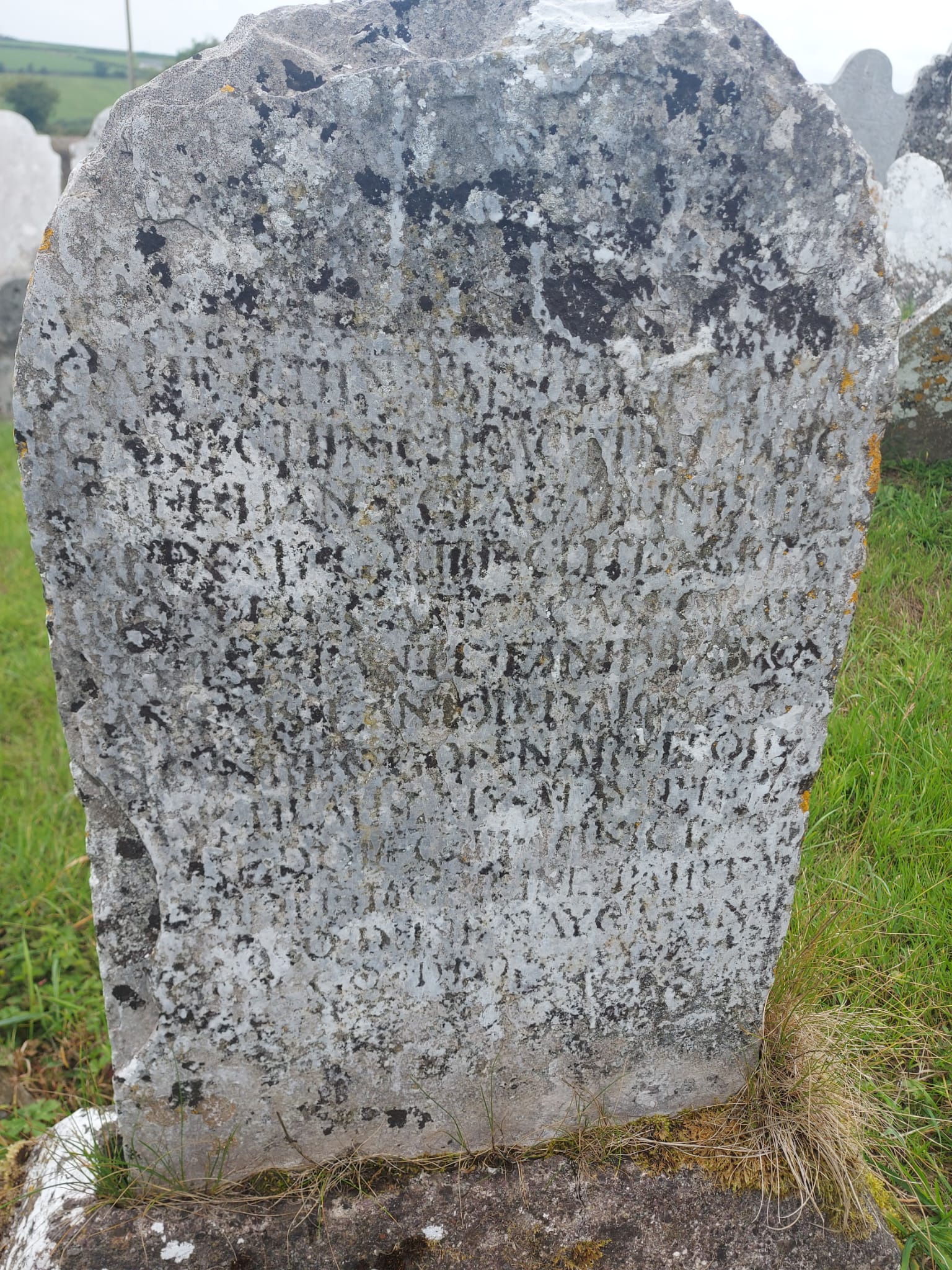
Irish Text Headstone at Templecurraheen Graveyard, Carrigtwohill
18th Century ‘Old’ Irish 21st Century Modern Iris
| Old Irish | Modern Irish | Translation |
|---|---|---|
| GEAR. GUIN. TAR. SINE. CREAG | GEAR GHAIN TAR SINE CREAG | Deep grief for our Sinead (Jane) Creagh |
| GARE. CUIN. CREACTIUH. LING | GEAR CHOIN CREACHTA LINN | Deep grief wounds to us |
| TU .CHANE. GEAG. ARUN. DUIL | TU CANADH GO H-EAG AR AN DTUL | You until your death used compose on the (poems) |
| YRINAH. GAUEF CLITE. SGREA | GHRIANA GAF CLOITE SA GACREA | Sunny hillock now laid low in the clay |
| MO. YILE. CASE. CASE. CRATO | MO MHILE CAS CAS CRAITE | My thousand sorrows sorrows tormented |
| BAUSE. TANTE. FANID. IS. BRON | BAS TAINTE PENNID IS BRON | Death speaking my pen is sorrowful |
| ANFAIS. LANIORL. DAIG. CAIG | AANFAIS LENAR DAIGH CAIGH | Now with whom we have followed |
| NO. NREOGON. NAR. YEROIL | NA LEOGHAN NAR DHEAROIL | The lines that did not die |
| =AR. FILAH. LAIY. ATAYIRT | SAR FHILE LAOI A TABHAIRT | Great poet (of the lays) to give |
| (N)ART. DOM. GUE. MINICK | NEART DOM GO MINIC | Me strength often |
| =E. HOLE. MO. RUNE. PAIRT | LE H-EOL MO RUN PAIRT | My intention love is to share |
| =LAT. GO.DUNE. NAYGA . AN | LEAT GO DUNA AN EAGA AN | |
| =UIYE.GO. DEO | OICHE GO DEO | With you until the end of the night FOREVER. |
This is a small headstone of limestone (18”x40”), dated ca 1780, written in the Irish language – which is a very rare occurrence, although Gaelic was still widely spoken. It is a lengthy inscription written in verse with semi-phonetic spelling using Roman capitals throughout. It is believed to refer to an unknown local poetess, Sine Greag. This stone was discovered by Richard Henchion and translated by Liam O’Buachalla and Sean de h’Ide. The first line reads:
GARE GUIN.tar SHINE CREAGH
And translates as ‘Deep grief for our Sinead (Jane) Creagh
When local historians first became interested in recording headstone inscriptions in local graveyards in County Cork, there were no known examples of any being in the Irish language. An article by archaeologist and esteemed local historian, Liam O Buachalla, was published in the 1962 edition of the Cork Historical & Archaeological Society Journal, and it mentioned a rare find in a local graveyard.
Templecurraheen graveyard is on a hill-top about two miles north west of Carrigtwohill village, on the road to Tibbotstown and Ballinakilla. It overlooks a large stretch of land and water which extends beyond Barryscourt and Fota Island towards Cobh. Rarely used nowadays, it has headstones dating back to the 1700’s. The rare find mentioned in the article was a headstone with an inscription in Irish. It was in poor condition when it was found and the inscription was very difficult to read. Liam O Buachalla devoted many hours to deciphering the letters, some of which were barely legible. He knew it was early Irish from the style of writing and the fact that only capital letters were used. He also knew that the stone dated from the late eighteen century, more than likely from the late 1780’s
It begins with details of a person’s name and place of residence and it was his opinion that the inscription was an epitaph to a Gaelic scholar who lived locally, in this instance a female poet. He tried to find connections to her by searching through parish records but was unable to get any further details. Liam O ‘Buachalla did a lot of research and was successful in translating certain parts of the inscription into Modern Irish. When no further progress could be made, his nephew, Donie Buckley, was asked to continue from where his uncle had stopped. It had been standing for over two hundred years and parts of the headstone had flaked of before the inscription could be studied. Some of the letters were either completely missing, or had parts worn away. Some words were spelt phonetically, others were mis-spelt, a few were unknown to us. The work of recording old headstones has grown in popularity in recent years but there are few examples of any being in the Irish language.
Sincere thanks and credit are due to archaeologist Richard Henchion for discovering this headstone and to Liam O’Buachalla, who began the study of the inscription over 60 years ago. My contribution was to piece together the missing parts and, in translating the words into Modern Irish, has been my way of acknowledging their valuable work.
Go ndearna Dia grāsta orthu uile.
Holly Bough article 2012