We Three Sang a Song in Honour of May at Her Cork Gravestone
Based on a column by John Arnold, published in the Echo, 7 May 2026
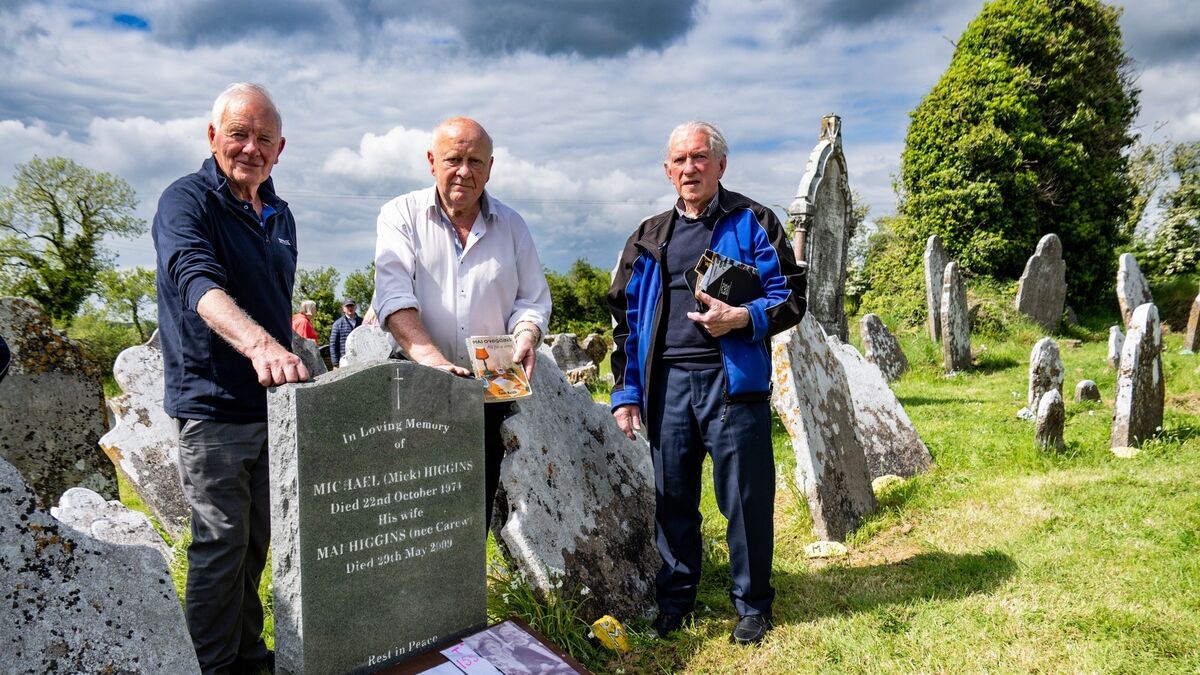
Photograph courtesy of the Echo.
A simple headstone on an East Cork hillside
Writing in the Echo on the occasion of the unveiling of the new Cork County Council information board at Templecurraheen, columnist John Arnold turned his attention to a quiet headstone in the graveyard — the resting place of Michael Higgins, who died in 1974, and his wife Mai, who passed away in 2009.
Six years ago, Arnold writes, Templecurraheen — set high on a hillside in the parish of Carrigtwohill — was in a sorry state. Like many other ancient burial grounds, the place was uneven and dangerous to traverse. A church once stood here, said to have been burned by the forces of Oliver Cromwell in the early 1650s, and not far away stand the gaunt remains of a famine workhouse, with a huge famine burial pit still visible at the back of the graveyard.
It was local man Michael Finn who singularly took on the task of clearing and cleaning this sacred ground. Arnold borrows a line that Robert Kennedy was fond of quoting from George Bernard Shaw — "Some men see things as they are, and ask why. I dream of things that never were, and ask why not." — and applies it to Mick Finn, whose dream came to fruition on the Monday of the unveiling, when a few hundred people gathered in glorious sunshine to see the burial ground transformed into a well-kept place of serenity and beauty.
May Carew of Dungarvan — Mai Higgins of Templecurraheen
Among the stones Michael Finn brought back into the light was one to Michael Higgins and his wife Mai. Sometimes called May Higgins, and sometimes Mai Ó Higgins, her name carried a special resonance for anyone who ever listened to Fáilte Isteach, the Saturday-night RTÉ radio programme presented by the great Donncha Ó Dúlaing. Many of the songs Donncha played — Sweet Youghal Bay, Gweebarra Bay, Beautiful Bundoran — were written by this Waterford lady.
Growing up in Dungarvan and Old Parish, young May Carew had a fascination for water — the sea, rivers, lakes — and penned many beautiful songs with a maritime theme. She met Garda Michael Higgins of Knockraha when he called to the Garda Station in Dungarvan and asked her to accompany him to a Garda dance. She said yes, and their love story began. While the couple were honeymooning, she wrote Moonlight On The River Shannon.
Though the Higgins family lived in Dublin for many years, May’s native Decies was never far from her mind. The Silvery Sands of Tramore, Comeragh’s Rugged Hills, and The Cross of Old Piltown all reflected her love for home. Perhaps her best-known composition, widely recorded, is Dungarvan My Home Town — truly a Waterford anthem. John Arnold notes that he has found more than fifty songs written by Mai Higgins.
A connection to Gortroe
Arnold’s own connection to Templecurraheen came through another grave entirely. In 1834, in his home parish of Bartlemy, twelve men were shot and killed at the Widow Ryan’s farmyard in what became known as the Battle of Gortroe. Among the dead were two brothers, John and Michael Collins, sons of the widow Mrs Collins, who were brought back to Templecurraheen on 21 December 1834 to be buried with their father.
For 150 years the actual location of their grave was lost. When a monument was erected at Gortroe in 1984, Paddy Healy — a relative of the family — could only place their wreath inside the graveyard gate. During the great clean-up, Mick Finn found the old, sunken Collins headstone, raised it, re-lettered it, and at long last added the names of John and Michael. Arnold was present last year when that stone was unveiled and blessed, and has returned many times since.
Three voices on the hillside
At the unveiling, Arnold was thrilled to meet an old friend, Dungarvan native Charlie McAllister — a great Gael, referee, and gorgeous singer who had once met May at a concert in their native town. He also met veteran céilí musician and singer Pat White, a life-long admirer of Mai Higgins who had known her in Dublin and who honours her memory by keeping her songs alive.
Together, the three of them — Pat, Charlie, and John — stood on the East Cork hillside above the Lee and Cork Harbour and sang, in honour of May, at her gravestone. As Arnold writes, her final resting place on that hillside surely makes her soul happy, looking out over the harbour she would have loved.
Source: John Arnold, “We three sang a song in honour of May at her Cork gravestone”, echolive.ie, 7 May 2026. Retold here with thanks to the author and the Echo. Photograph courtesy of the Echo.